The sheer orange scarf falls away to reveal her right arm.
She is missing her hand.
She is sitting between two men.
To the left, her husband, stoic, serious, lifeless.
To the right, the man who cut off her hand.
She sits next to the man who cut off her hand and assumed she was dead; he left her with his animal friends who hacked at her face with machetes.
People can be taught to be cruel.
The white in his eyes is flashing, but he is gentle with her, and they lean their heads close together and whisper.
What are they talking about?
As her husband sits poised,
a statue. Nonexistent.
What does he think of this man?
People can be taught to forgive.
But what sickness of lies will eat them from their guts when they realize
the script of reconciliation?
The Interhamwe said they didn't have a choice.
To accept the French machetes.
To spit on the faces of their cockroach, dehumanized victims.
To rape women and cut their stomachs.
To burn churches.
To crush infants against walls.
To kill.
Now, I ask you, woman in the orange scarf -- do you have a choice not to forgive?
Sunday, June 17, 2012

Saturday, June 16, 2012
Magnolia syrup

Magnolia syrup does not exist. But this girl, with the tropical magnolia tucked behind her ear, has an idea for a new treat. Now, to channel the inner chemist within her. How can she turn this flower, which smells like biting into peaches and honey, into something bottled?


How can I bottle Rwanda?
Ha! What a ridiculous and slightly horrific idea. Ah, but I've already reached the halfway point, and I don't feel as though I've been able to tell you about Rwanda. I don't feel as though I've been able to tell myself. So, I've just been trying to catch senses -- literal senses like sight, taste, smell, touch and the cars and crows and shouts and songs and sizzles that I hear.
Yesterday, I heard a man say this after someone pointed to a baby on a mother's back: "She carries her baby like that because we were all carried that way. I was carried like that when I was a baby. I'm sure Emmanuel was carried that way. We are all carried the same way."

Common ground. The human condition.
We all began the same way.
And we can connect through these realities.
Connection.
Every day we eat together; we are hungry together. The colors of the food match their tastes. The colors are Earthy oranges, browns and greens, and I fill my entire plate with grains and meats and legumes that are creamy and complimentary. The cassava leaves are sweet, the texture melty and comfortable. The potatoes and bananas are thick with freshness. The avocados are velvet spoonfuls and can match the length of my hand. I mix this all with the rice, and I realize that what I'm eating came from dirt not too far away from where I am sitting.


I keep thinking about what the man said about the tradition of babies on mothers' backs and about the simplicity of salivary glands and digestion. We are all more similar than we think, yet we obsess with differences. We must all be better than one another, for what -- for self-actualization? For class success? For economic success? For power? Within every niche of life, there is someone who is striving to be better, and therefore is striving to be the best. Competition. Competitive nature. This helps us build cities and computer programs...as we grow further and further away from each other.
Just some magnolia syrup musings for tonight.
Tomorrow, we are going to the closing ceremony of the Gacaca Courts, the traditional court system used to bring justice to genocide survivors and jail perpetrators. The courts are closing. There will be no more testimonials. There will be no more sentences. So, it's over? Justice is fini?
Yet again, it's those in power who are making this decision.
(Insert: Motives.)
Ay. I'll post more magnolia syrup musings tomorrow.
Bonsoir.
Yanna
Tuesday, June 12, 2012
Where the wild things are
In the midst of being in a place where everything around me is bigger than I am, we went to Akagera National Park in northeastern Rwanda. Here, everything is bigger than me in a different way.
Quick personal history: When I was younger, I secretly wanted to be a marine biologist, even though I did not particularly like science. The only science class I really liked was astronomy, and that would not help in my potential marine biology profession. I also was not a very good swimmer. I never learned how to properly dive, and the swimming instructor always had to hold my ankle and flip me into the water so I wouldn't belly-flop.
Don't ask me why. But I wanted to be a marine biologist. Kind of. I also wanted to be an actress and a singer and a writer and a humanitarian.
I love animals. That's what it is. When I'm running on the treadmill at the Rec Center, I watch "River Monsters" on Animal Planet. When I see a random dog on the street, my voice transcends octaves into a horrifying baby-screeching: "Awwww doooggiiieee!" It's embarrassing. When I went snorkeling in the Pacific Ocean, I almost hyperventilated when a bat ray swam under me, its movement so effortlessly cool.
The trip to Akagera was my first safari. It goes without saying that my voice was looping in and out of soprano ranges.
The drive to Akagera was beautiful. We saw rice fields and sorghum fields and cassava trees and banana trees. We passed through villages where women carried their babies wrapped in scarves around their waists, men balanced planks on their topheads and children chased each other in the yards. At this house, Emmanuel asked the driver to stop so he could buy two bunches of sorghum for 4,000 francs. The photographs that follow are little capsules into my car ride view.




Quick personal history: When I was younger, I secretly wanted to be a marine biologist, even though I did not particularly like science. The only science class I really liked was astronomy, and that would not help in my potential marine biology profession. I also was not a very good swimmer. I never learned how to properly dive, and the swimming instructor always had to hold my ankle and flip me into the water so I wouldn't belly-flop.
Don't ask me why. But I wanted to be a marine biologist. Kind of. I also wanted to be an actress and a singer and a writer and a humanitarian.
I love animals. That's what it is. When I'm running on the treadmill at the Rec Center, I watch "River Monsters" on Animal Planet. When I see a random dog on the street, my voice transcends octaves into a horrifying baby-screeching: "Awwww doooggiiieee!" It's embarrassing. When I went snorkeling in the Pacific Ocean, I almost hyperventilated when a bat ray swam under me, its movement so effortlessly cool.
The trip to Akagera was my first safari. It goes without saying that my voice was looping in and out of soprano ranges.
The drive to Akagera was beautiful. We saw rice fields and sorghum fields and cassava trees and banana trees. We passed through villages where women carried their babies wrapped in scarves around their waists, men balanced planks on their topheads and children chased each other in the yards. At this house, Emmanuel asked the driver to stop so he could buy two bunches of sorghum for 4,000 francs. The photographs that follow are little capsules into my car ride view.


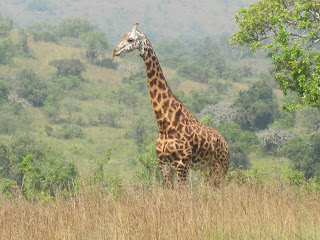
When we reached the park, we doused ourselves with bug spray and set off with our guide. The terrain was jostling, but this was the real deal. We opened the windows and did not blink. First, we saw impalas, which are like deer; this is where it began. Then came baboons and boar and hippos and zebras and a grand, graceful giraffe that lumbered off after staring at us -- the strange white boxy creature in front of it -- for a few minutes.

Disclaimer: Please note that all of these pictures are of animals running away from us, but that I actually think they were very happy to see us. Except the boar. They didn't move an inch. Couldn't be bothered.


Then there was this moment. The moment when a hippopotamus appeared from behind the bush, scooted in front of us and then slipped into the lake. It was unreal at first, the fact that a hippo was in my presence -- was this a character from one of my favorite children's books? No, it was not 2D, it was 3D and it was here with me.


And how could I forget the water buffalo, creatures who stick closely together and stare at us as we stare at them. Here, the last of the wild things.

And finally, here are the other wild ones. I hope you've enjoyed your virtual safari tour! Ijoro ryiza.

Yanna
I can still smell Murambi
I can still smell Murambi.
The day after Murambi, I woke up and there seemed to be something thick in my sternum. I felt sick. It was the smell of Murambi.
The drive to Butare was beautiful. I tried to catch the passing scenes.


The day after Murambi, I woke up and there seemed to be something thick in my sternum. I felt sick. It was the smell of Murambi.
The drive to Butare was beautiful. I tried to catch the passing scenes.


When we reached Butare, we went to the King's Palace and I took some pictures on my film camera. The guide led us through the king's hut and then to his palace. We stopped by a field and saw the longhorn cattle with glossy fur; a man in rain boots climbed into the pasture and chose one cow to demonstrate traditional cow singing. He began singing and led the cow to the fence; he sang praises in Kinyarwanda: "You are so beautiful; you give us precious milk." The cow's head sank to the ground and he stood hypnotized. When the man finished his praises, the cow lifted his head and grazed the man's face, first with his nose, then with his tongue.
After the king's palace, we went to the Ethnographic Museum of History. It was fascinating to see the developments of traditions through history.
Then, we went to Murambi.


Murambi is a technical school on a hill surrounded by many other hills. The mist was heavy that day, but I could see all the houses that enveloped this hiding place. This was not a hiding place at all. But more than 50,000 took refuge here and hoped to live. And those who lived in the surrounding hills kept count of who came to Murambi; genocide ideology was thick here -- in ministers, businessmen, farmers and political leaders. All were watching.
Like Nyamata, Murambi has kept the remains of those who were killed here; most of them have not been identified. There are 25 rooms of remains. Or, I should be more specific -- there are 25 rooms of remains that have been mummified. They were found in shallow graves; the dirt was cold, so their skin remains. And now, in those 25 rooms, you can see the figures of emaciated bodies, some with their mouths gaping in a scream. (For pictures: http://homepage.mac.com/stevesimonphoto/Murambi%20Memorial/index.html).
There is one room, The Children's Room, that is filled with infants and small children, their white skins dusty and rigid. In another room, two skins are latched together -- that of a mother and a child -- by a piercing spear.
To be killed holding your own child...to be killed trying to protect your child...
What happened here?
Murambi Technical School was painted to be a haven. The French Army told Tutsis they would be safe here, but when the school was full, they retreated. They cut off the water and electricity and waited for the Hutus to prey upon their fished victims. When these Tutsis realized their protectors had abandoned them, they gathered rocks to fight off the Hutus, but after a couple days the rocks were no more. They were overtaken and massacred.
There is a field behind the brick buildings where the bodies are kept. In the field, there is a sign about the French Army -- the army that felt nothing human, only villainous pride for their country and their language. After the Hutus had finished their "work," the French Army buried the mutilated and disfigured bodies in mass graves behind the school and played volleyball on top of the freshly planted graves.
Humanity, humanity, humanity, where did you go?
We felt overwhelmed in the presence of these ghosts that did not seem fully dead. Like Nyamata, again I wanted to sit with them. But I did not. Instead, we folded into each other and sobbed loudly. Our guide, a genocide survivor, was afraid of our noises and walked away, leaving us with the bodies. She witnessed genocide, yet she still cannot witness a vocal emotional response to the memory of massacre.
When we walked back to the front of the school, we sat on the steps and did not speak. We were all trying to swallow but there was some kind of obstruction. I did not know what to say. I did not know what to write. I opened my journal and bent to the ground; I pressed the blank, open page into the dirt and scraped and scraped until the sound of grainy dissonance seemed permanent. I did not know what to write. But I wanted to remember.
Now, the smell of air contacting dead skin is permanent in me.
Yanna
Monday, June 11, 2012
It continues
I remember the peace I felt driving into the cooperative in Nyamata. Of course I remember it -- it was only a few days ago. But it's not so much about the memory itself, but the memory of how I felt. It's almost like I was a different person then. Does that make sense? That was only four days ago.
We moved benches into the front yard and four people sat down in front of us: one woman and three men. The woman holding the stoic baby and the man with the blue Champions shirt are both survivors. The other two men -- Frederick and Matthew -- sitting in between them are perpetrators of the genocide.

We moved benches into the front yard and four people sat down in front of us: one woman and three men. The woman holding the stoic baby and the man with the blue Champions shirt are both survivors. The other two men -- Frederick and Matthew -- sitting in between them are perpetrators of the genocide.

We listened to their testimonies.
Frederick, on the far left, is the president of this cooperative, a cooperative that was initiated by a Catholic priest who helped imprisoned perpetrators ask for forgiveness in 2003. In 2003, President Kagame released a statement that any guilty perpetrator currently in prison could ask for forgiveness for what he had done and then be released. The prisons, apparently, were overcrowded to a point of inhospitality. The Catholic priest went to the prisons and did what I will call "recruiting." He "trained" these perpetrators how to repent and ask the government for forgiveness; upon their release (now the prisons were less crowded and more manageable), the perpetrators were given benefits, like housing. Like the housing in Nyamata.
So how did they come to be neighbors by choice? Choice, here, is used quite loosely. Thousands of survivors were stripped of their property after the genocide, and therefore, needed housing. This "ideal" cooperative, for some survivors, was simply convenient.
The man in the blue Champions shirt is a genocide orphan. His face was pink guava (read: rosy) and he smiled easily, especially when Bea asked them to give each one of us a Kinyarwanda name after we had introduced ourselves. Frederick immediately named me "Umutoni," which means "the preferred one," and the man in the blue Champions shirt grinned, his teeth only slightly off-kilter.
He and the woman each said, in their testimonies, that they had found a way to forgive, and that it came from the heart, and in one case -- I can't remember who -- from God.
Frederick and Matthew each admitted to killing people during the genocide (Matthew admitted to killing six people he did not know). They each attributed their bloody hands to a "bad government" and "the devil." They each attributed their bloody actions to a trap -- a governmental trap; a devilish trap. Frederick admitted that he had fallen into this trap and thus, he had become an animal, not aware of his own actions.
This is why they killed.
When it was time for questions, I had a few but I only asked one. The shuffling and shouting children were hard to ignore during the presentation; they whispered on the other side of the bushes and peeked their heads over to stare every once in awhile. I had a question about the children. What lessons do you or will you teach your children about what you experienced, and what can they learn from the history of Rwanda? I suppose I should have been more specific, because the answers I received were completely empty and unfinished.
In so many words, Frederick said he would tell his children about the trap he succumbed to. But, in fact, he said nothing about what he did -- he did not take ownership. It was simply a bad direction from a bad government. Matthew's body language was disturbingly expressive, like he was having an uncomfortable nightmare. Like he did not want to be there. He fidgeted and covered his face; when his face was not covered, his eyes were wild.
And so, my question was not answered. And the question still lingers. If you claim to be a part of a society of reconciliation, you must involve the next (innocent) generation. You must first take ownership for your own actions -- do you not feel regret? -- and claim responsibility of your actions. Because at the very last moment, it was not the government, it was not the devil, it was you who struck the man, woman, elder or child and ended their life. You had the agency, choice and ability to not commit murder, but you did.
You.
Now I wonder. Who will teach these children how to take responsibility for their actions? Who will teach these children that they have agency over their actions? Who will teach these children they are able to say no? Who will teach these children that their individual decisions -- their personhood -- is more important than an infectious ideology? Who will teach these children what an ideology is? Who will teach these children that it was years of dehumanizing discrimination that led to the genocide of the Tutsis in 1994? Who will teach these children that it was not just a bad government, but all of those who lost their personhood to the performance of violent judgement that led to the murder of more than 1 million Tutsis over the course of 100 days? Who will teach the real history of Rwanda?
These are the lessons I wondered about. These are the lessons I wonder about.
We left Nyamata, and I did not feel peace. I was a rice field trampled by water buffalo. I had been affected.
Two days later, we went to Murambi.
But first: a note on reconciliation politics. In a society of reconciliation, the perpetrators are the ones who take one step back into society: "asking forgiveness." The survivors are disabled by "norms" before they are even able to take an actual step. These "norms" say that those with a heavy past should have hope and forgive. Therefore, "asking forgiveness" is in itself a constructed norm of the dynamics of this society. If survivors are expected to forgive, then perpetrators should ask forgiveness; this is the "norm" logic.
But we are forgetting about closure. We are forgetting about the mental health of those who have been traumatized. We are forgetting about memory. We are forgetting about HIV, children born from rape, physical scars, etc. In this society of reconciliation, the survivors and perpetrators live in proximity of one another, and yet, they have been hindered from integrating what happened -- survivor or perpetrator -- into their every day knowledge.
I will leave you with another anecdote from the lecturer who helped me understand reconciliation politics. And then I will tell you about Murambi. And the National Park. And people watching from the tailor's doorway this afternoon. But first, this:
"The world has become a village. Look at you here -- you will have to meet someone new from foreign soil and you will have to know how to understand and communicate with them."
This is my struggle. How can we communicate, all of us, together, and welcome compassion into the international community?
Yanna
To be continued...
It's hard to start this one. In 30 minutes, we're going to the tailor to be measured for our dresses. We each chose fabric for our traditional African dresses. Here's my fabric: (I'm so excited!!!!!)


It's hard to start this one because I have so much to say, but I don't know where to begin. We're always go-go-going, and I love it. I love the adrenaline and the surprises and the people and the places, but I must remind myself to write. I have a Moleskin journal from my very very amazing, beautiful, wonderous best friend, Alex, who is wanderlusting through South America right now. She's on her own adventure. She reminds me to write. The journal reminds me to write. I remind myself to write, and when I don't write I feel as though something is amiss.
So, let's go.
I'll start with after Nyamata. Last Thursday. We drove straight from the memorial site to a cooperative of about 50 houses where survivors and perpetrators live side by side. My skin was still crawling because I had not wanted to leave the church. We drove on a narrow pathway to the cooperative and children flooded toward our bus, yelling "AMAKURU!" and matching their hands with ours through the window glass. I felt calm because I imagined myself entering into the ideal community in this post-genocide society where victims and perpetrators are living with fear, grief, remorse, regret, etc.; I felt that this community -- a community where survivors and perpetrators have chosen to live neighbor to neighbor -- was something hopeful.
We stopped at this house and sat outside in a circle on benches.

And they talked, and we listened, and we asked questions, and I did not feel satisfied.
To be continued...
Yanna
Friday, June 8, 2012
I have to be honest
It's getting harder to write blog posts. In fact, I've avoided doing it for a couple days now. The pictures I want to show you don't entirely match the feelings I've been experiencing. So, I don't know how to break it up. I don't know what to say. I don't even know who's reading this.
I was hoping to document all aspects of my days, but that is hard. First of all, when we go to memorial sites and visit survivors and perpetrators, I am listening and observing, and in most instances, I feel disrespectful taking a picture. I don't know what this blog is. It's not just me posting a picture with a caption, "Pic of the memorial site. Had fun today!" Even just joking about that makes me uncomfortable. What I am experiencing is important, and I believe every single person should experience this. But, on that note, I am finding it hard to communicate. Usually, I find that I am best with words. But this is hard. I don't know what else to say. It's hard.
But I'll try.
I don't want you to read this and look at my pictures and feel sorry for any of the people I tell you about. I don't want you to feel pity. That's not what this is about. This is about humanity. This is about communication. And this is about truth. This is not only about opening oneself up to the traditions of a culture and understanding the political, economic and social constructs of a society, but also remembering the core of being. What happens when part of a population fails at maintaining its humanity? What happens when someone loses part of their being? That's what this is about. There is no pity in that. There is no egocentrism. There is no ethnocentrism in that, and in fact, if there is, that is one of the elements that propels this sort of behavior. We are not invincible. We are not better. As an international community, we cut clear distinctions and divisions; we do not wish to connect, truly. And because of this, we fail when humanity challenges us.
We are not invincible.
Armenia, 1915 - 1918.
Eastern Europe, 1941 - 1945.
Cambodia, 1975 - 1979.
Argentina, 1976 - 1983.
Bosnia, 1992 - 1995.
Rwanda, 1994.
How did this happen? How did it all happen? You cannot ignore it.
Even now, I am facing a wall. I have so many thoughts; I don't know how to continue. I will start with yesterday.
We drove to Nyamata, a village about 30 minutes south of Kigali, and during the ride I just wanted to be silent. Ellen was snapping pictures because she's good at catching the right moment of passing trees and scenery. Me, I just looked. I wish I could show you. We tried to catch all the evanescent hills while Emmanuel told us the story of how and where his family had been killed and how he had pretended to be Hutu in order to survive as he traveled through the bush. There was a dichotomy of vision as we traveled; I imagined the farms, river, hills, fields, cows, goats and homes as they were in the present, and I imagined them as they were in 1994. That is how I feel when we travel or walk through Kigali. That is how I feel when we pass over the bridge where the UN Senegalese officer Captain Mbaye Diagne was killed by a random mortar shell that landed near his Jeep. Although Diagne worked for the UN, he ignored their commands to not intervene and conducted solo missions to save Tutsis. It is unknown how many Tutsis he saved, but no matter the exact number, he was one of the just.
I am always thinking of 1994.
When we reached Nyamata, we pulled up to the gates of a church. It was the Nyamata memorial site (http://www.kigalimemorialcentre.org/old/centre/other/nymata.html). A young woman with braids gave us a tour; it actually went quite quickly. Everyone was silent. We walked into the church to heavy piles of clothing sitting on the pews, bullet holes casting tiny openings of dusty light onto the floor and remnants of blood on the walls. This church is where approximately 2500 people were trapped and murdered after being separated into groups. The children were forced into one corner of the church and they watched as their parents, siblings, relatives and friends were killed with machetes and clubs; they thought they might be spared. But they were killed last; many of the infants were killed after being smashed or thrown against the wall. Downstairs, the remains of the bodies have been maintained in glass cases. There are skulls lined up one after another to show the brutality of the murders and the way the machetes were used to massacre. On many skulls, you can see the swiping scar of a deadly machete blow. It looks much like a crescent moon that has been pulled tightly at both ends. Underneath the glass cases, there is one coffin that is decorated with a silk covering and a brown cross. It is a woman who was raped and then horrifically mutilated; the perpetrators inserted a spike into her vagina and left her for dead. Outside of the church there are burial sites. Under the burial sites are more remains -- this time skulls, bones and other coffins.
These people trusted a higher spirit, they trusted their priest, they trusted the church. And they were not safe.
When the tour was over, I went back inside the church and sat on a ledge where I could see all of the pews. There were striped shirts, torn hats, sneakers -- all overwhelmed with dust. I cried. No matter my spiritual beliefs, I felt that I needed to sit with them for awhile. I could feel them in the church with me, and I cringed and cringed to see their faces. I wanted to know them and see them there with me. I wanted to shake their hands and tell them I that I am sorry. I wanted to take full responsibility for their deaths, even though I did not kill them, because I know that their justice is slow and nonexistent. Even so, they calmed me when I was sitting in the church with them, and I did not want to leave.
And here I am again, I think I've hit another wall. I feel the gravity. And there is dissonance within me when I think about now, the post-genocide society, and the memory and reality of sitting in the Nyamata church.
How can we reconcile this? How can we rebuild ourselves? How can we prove that we are really doing this, and not just moving on?
Thank you for reading this, whoever you are. I think your eyes are important. But please remember to not forget.
I will leave you with a simple thought one of our lecturers said today when discussing reconciliation politics.
"We have trees all over these hills that we cut down, but we do not extract the roots. If we do not extract these roots, we are in trouble. But we do not think this way. But we must."
Yanna
I was hoping to document all aspects of my days, but that is hard. First of all, when we go to memorial sites and visit survivors and perpetrators, I am listening and observing, and in most instances, I feel disrespectful taking a picture. I don't know what this blog is. It's not just me posting a picture with a caption, "Pic of the memorial site. Had fun today!" Even just joking about that makes me uncomfortable. What I am experiencing is important, and I believe every single person should experience this. But, on that note, I am finding it hard to communicate. Usually, I find that I am best with words. But this is hard. I don't know what else to say. It's hard.
But I'll try.
I don't want you to read this and look at my pictures and feel sorry for any of the people I tell you about. I don't want you to feel pity. That's not what this is about. This is about humanity. This is about communication. And this is about truth. This is not only about opening oneself up to the traditions of a culture and understanding the political, economic and social constructs of a society, but also remembering the core of being. What happens when part of a population fails at maintaining its humanity? What happens when someone loses part of their being? That's what this is about. There is no pity in that. There is no egocentrism. There is no ethnocentrism in that, and in fact, if there is, that is one of the elements that propels this sort of behavior. We are not invincible. We are not better. As an international community, we cut clear distinctions and divisions; we do not wish to connect, truly. And because of this, we fail when humanity challenges us.
We are not invincible.
Armenia, 1915 - 1918.
Eastern Europe, 1941 - 1945.
Cambodia, 1975 - 1979.
Bosnia, 1992 - 1995.
Rwanda, 1994.
How did this happen? How did it all happen? You cannot ignore it.
Even now, I am facing a wall. I have so many thoughts; I don't know how to continue. I will start with yesterday.
We drove to Nyamata, a village about 30 minutes south of Kigali, and during the ride I just wanted to be silent. Ellen was snapping pictures because she's good at catching the right moment of passing trees and scenery. Me, I just looked. I wish I could show you. We tried to catch all the evanescent hills while Emmanuel told us the story of how and where his family had been killed and how he had pretended to be Hutu in order to survive as he traveled through the bush. There was a dichotomy of vision as we traveled; I imagined the farms, river, hills, fields, cows, goats and homes as they were in the present, and I imagined them as they were in 1994. That is how I feel when we travel or walk through Kigali. That is how I feel when we pass over the bridge where the UN Senegalese officer Captain Mbaye Diagne was killed by a random mortar shell that landed near his Jeep. Although Diagne worked for the UN, he ignored their commands to not intervene and conducted solo missions to save Tutsis. It is unknown how many Tutsis he saved, but no matter the exact number, he was one of the just.
I am always thinking of 1994.
When we reached Nyamata, we pulled up to the gates of a church. It was the Nyamata memorial site (http://www.kigalimemorialcentre.org/old/centre/other/nymata.html). A young woman with braids gave us a tour; it actually went quite quickly. Everyone was silent. We walked into the church to heavy piles of clothing sitting on the pews, bullet holes casting tiny openings of dusty light onto the floor and remnants of blood on the walls. This church is where approximately 2500 people were trapped and murdered after being separated into groups. The children were forced into one corner of the church and they watched as their parents, siblings, relatives and friends were killed with machetes and clubs; they thought they might be spared. But they were killed last; many of the infants were killed after being smashed or thrown against the wall. Downstairs, the remains of the bodies have been maintained in glass cases. There are skulls lined up one after another to show the brutality of the murders and the way the machetes were used to massacre. On many skulls, you can see the swiping scar of a deadly machete blow. It looks much like a crescent moon that has been pulled tightly at both ends. Underneath the glass cases, there is one coffin that is decorated with a silk covering and a brown cross. It is a woman who was raped and then horrifically mutilated; the perpetrators inserted a spike into her vagina and left her for dead. Outside of the church there are burial sites. Under the burial sites are more remains -- this time skulls, bones and other coffins.
These people trusted a higher spirit, they trusted their priest, they trusted the church. And they were not safe.
When the tour was over, I went back inside the church and sat on a ledge where I could see all of the pews. There were striped shirts, torn hats, sneakers -- all overwhelmed with dust. I cried. No matter my spiritual beliefs, I felt that I needed to sit with them for awhile. I could feel them in the church with me, and I cringed and cringed to see their faces. I wanted to know them and see them there with me. I wanted to shake their hands and tell them I that I am sorry. I wanted to take full responsibility for their deaths, even though I did not kill them, because I know that their justice is slow and nonexistent. Even so, they calmed me when I was sitting in the church with them, and I did not want to leave.
And here I am again, I think I've hit another wall. I feel the gravity. And there is dissonance within me when I think about now, the post-genocide society, and the memory and reality of sitting in the Nyamata church.
How can we reconcile this? How can we rebuild ourselves? How can we prove that we are really doing this, and not just moving on?
Thank you for reading this, whoever you are. I think your eyes are important. But please remember to not forget.
I will leave you with a simple thought one of our lecturers said today when discussing reconciliation politics.
"We have trees all over these hills that we cut down, but we do not extract the roots. If we do not extract these roots, we are in trouble. But we do not think this way. But we must."
Yanna
Subscribe to:
Posts (Atom)