Wednesday, July 4, 2012

A dedication

I'm back in the States.

And it's strange. I am experiencing what some call reverse culture shock. And, okay, it's true. I'm a bit shocked. But mostly I'm feeling out of place. I'm feeling like I was dropped from a spaceship back into this place where I used to live. And everything is just how I left it, except for a few more dust bunnies gathered around the bookshelf. The old magazines -- the ones I don't care about anymore -- are next to the couch. The empty wine bottles are one top of the fridge. The mismatched stack of papers from last semester -- notes on storytelling, hip hop feminism and Chinese immigration -- are still teetering dangerously on the heater. My friends are here (except for a few of my babes who are galavanting across the country and/or world), talking about parties and work.

I don't want to talk about parties and work. I want to talk about Rwanda. I'm still there.

I feel like I time-traveled. I went forward and now I'm back.

So, how can I stay there but be here?

I have a friend, Emily, who inspires me every time I see her. She was the first person I saw when I landed back in Columbia after my boyfriend picked me up from the airport with flowers in his hand.

This is Emily.


I was so happy to see her, because seeing her meant I could be honest. I told her how I felt and immediately felt at home. This is what she wrote me in a letter decorated with an original watercolor of a vegetable-themed bicycle:

"Although I didn't make that trip to our beloved Africa with you, I've been thinking of you for weeks now, trying to remember what it was like to transition back into the States. You say you feel 'out of place' and 'a little off.' I've got to share with you, Yan, that I still feel off. But off is good. Off means that you're thinking, feeling, noticing, reflecting. If we weren't 'off,' we'd just be numbly living."

She's right. And now that I've integrated myself into another world -- Rwanda -- I can bring part of Rwanda and myself back into this place. I can share Rwanda's stories with people in my community, and I will. If I need to shout, I will. If I need to repeat myself, I will. I won't ever deny how I feel right now -- a little alien, a little shaky like newborn impala legs. A little out of place, but full now, full with inspirations and plans.

So, let's start.

This is my friend Emmanuel. He lives in Rwanda. But I brought a little bit of him with me to the U.S.


Emmanuel picked me up from the airport at midnight whenever it was I landed -- June 1, I believe. He was tall, I remember, but my glasses kept sliding down my nose and I was tired and confused from all the layovers and plane rides. But I know I liked him right away. He was comforting. Welcoming.

He scooped up my awkward luggage and said, "Here, let me." From that moment until now, he was my guide, my translator, my storyteller, my teacher and my friend.

This post and the rest of my blogging is dedicated to Emmanuel. And to every Rwandan who welcomed me into his or her life and trusted me, a stranger, with their stories. I'm keeping them with me and passing them on. 

The stories start now.

I hope you are ready to listen.

Yanna

Sunday, July 1, 2012

Turasubira

See you soon.

I want to pretend I'm sitting at a round table giving a toast. Around me are all of my closest friends and those who make me better. I don't want to get sentimental, but I have to tell you about Rwanda. I have to tell you now because soon I will be gone.

I've already got that sinking feeling like I'm dipping down from the height of a ferris wheel. One month is not enough. One month is not enough after you've found a place that could be your home. I remember how I felt one month ago -- giddy, young, unsure. The dust and vibrant fabrics and grumbling motors gave me tiny headaches in the beginning. But then I didn't know. I didn't know how quickly those stimulations would become a part of me.

Here, in Rwanda, I walked the broken streets and the clay-like dust stained my toes. Here, in Rwanda, I  stuffed my belly with local spices and plants. Here, in Rwanda, I zipped through stalled cars on a flying moto; an old man resting in the shade of a tree smiled at me and motioned for me to lower the visor of my helmet. Here, in Rwanda, people looked out for me. Here, in Rwanda, I sang songs with my moto driver even though we did not speak the same language. Here, in Rwanda, I played Cat & Mouse with the kids. We chased each other and giggled and held hands. Here, in Rwanda, I danced with my arms extended to the sky, stretching, smiling. Here, in Rwanda, I shopped for biscuits and eggs next to women in business suits and men with children trailing their tails. Here, in Rwanda, I became someone's daughter. Here, in Rwanda, I became someone's friend. Here, in Rwanda, I became one of them.


I will miss this place and it is not possible to equate how much. Here, I learned about the resilience of the human condition; I learned about connection, communication and humanity.

Rwanda, you humbled me. Thank you for teaching me how to be human.

Turasubira. See you soon. 


Cheers.

Yanna

Monday, June 25, 2012

Notes from an observer

Here are some notes from my observations of living in a new world. No photos necessary.

Dancing


The first club we went to was in Gisenyi. We showed up at 11 p.m. No one else was there. In Rwanda, clubs don't get feisty until midnight or 12:30. But at the time, we didn't know this, and we were impatient. Is there somewhere else we could go? We asked Emmanuel. We just wanna dance (every woman's mantra). No, this is the only club in Gisenyi. So we went inside. What ensued for the rest of the night until about 4 a.m. was magical.

Disclaimer: You should know something about me. I love to dance (every woman's mantra). But no, I actually love it. (Blame my parents. Gretch gets saucy to blues. Jacek gets sassy to Afrobeat). It's how I bond with new friends. Over a great, groovy dance. I love to throw my head back and circle my arms and dip my hips. I can dance for hours (see above). Keep this in mind as you read my commentary about dancing. For example, when I describe a night of dancing as "magical," it's because I legitimately thought it was magical; for someone else, it may have been just "really fun." For me -- spellbinding, sensational, staggering and every other gilded synonym.

We ordered drinks and embraced the awkwardness of being the only folks inside the pumping, flashing room, except for a couple shifty characters who were silently sipping on various kinds of liquors at the bar (these shifty characters are universal). I was actually nervous. Or perhaps just anxious. I wanted the locals to show up and show me how they dance. Dancing is communication to me, so really, I was "nervous" for our first meeting.

So we got groovy.

People flooded inside and of course we were the strange ones, dancing strange moves in the center of the floor. Little did we know, Emmanuel had been approached by a few men who had asked how he'd "gotten so many girls." Ha! He explained that he was our body guard and that we were all ambassadors' daughters. Had we known this, perhaps we would have danced a little more conservatively (but probably not). But the vibes in the room were infectious. We integrated into a circle of dancers -- us and the Rwandans -- and each took a turn in the center. We were wild.

The international language of dance.

Except this: I'd noticed this sweet and genuine behavior pre-Gisenyi club, but here it was apt and accentuated by strobe lights. Rwandans are affectionate. Bea had told us, before we'd jetted off, that there would be a lot of hand-shaking. And she was right. But she'd said nothing about the affection between friends, just the affection between strangers.

And here's the truth: In the United States, hand-holding between friends is marketed as feminine -- two women can hold hands without necessarily being labeled gay, but two men cannot. In Rwanda, I see the same methods of affection in both genders. Men will pull each other close and keep their arms wrapped around each other if they are discussing something intimate. Men will hold hands walking down the street if they are deep in conversation. Men will pull other men onto the dance floor for a particularly groovy song. And men will dance with other men to that particularly groovy song.

It's this culture of proximity. In such a small country, Rwandans live close together, work close together, discuss close together, play close together and dance close together.

Talking

(From my journal of observations at Avenir).

Counseling session.

Sitting in the room with the women who are widows of the genocide. Listening to them, not understanding what they're saying because this is a conversation among women (my translator is male). It doesn't matter.

One woman jumps out of her seat with glee to greet me, and they all hug me tightly and burst into giggles when I say "Amakuru...Ni meza." We each hug cheek-to-cheek three times each and then I sit down. They have removed their shoes and they are barefoot, exposed to each other. I do the same.

Emmeliene begins with what I interpret as a story because the other women hum and click in response. Her voice is soft. They listen. And then, out of cadence, they each speak.

They each tell their stories and lean in on their bare feet to listen to each other, sucking their cheeks in and smacking when they hear an injustice. Emmeliene sits forward as well, allowing the women to control the discourse, but they are aware that she is there; she is their anchor.

There's something about the Rwandan people I've noticed. The women in the room at Avenir would hum, click and hiss, hum, click and hiss, listening. When someone -- any Rwandan -- speaks, the listener is vocal and active as he or she listens, showing that the speaker's words matter.

I have found myself doing it, too. When someone speaks to me, I hmmm when I agree and euhm when I need clarification. Listening. Digesting.

I am Rwandan when I speak. And I am Rwandan when I dance.

Yanna 

Wednesday, June 20, 2012

The women/Les femmes

Lost in translation.

But only the words. Not the faces. Not the laughing. Not the babies. Not the walking. Not the eyes. Not the hugs. Not the hands.

Not the women. Je comprends les femmes.

There are three languages circulating. Kinyarwanda. French. English. I speak English quite well. I speak French like a 5th grader. I speak Kinyarwanda if you consider "How are you?" "I'm good" and "Thank you" conquering a language.

But the women. There's something about being a woman.

A woman I will call Grace said it best. Grace came to our home last week to share her testimony. Her face was soft, open -- she seemed to be younger than me. But she was 26 in 1994, and she experienced an incomprehensible hell. We sat on the black leather couches and she told us about it. We were stone.

She was saved by a Hutu who kept her in his home and then went next door to kill. (That is one thing I will never understand about genocide. How can you justify to yourself saving one and then killing others? Why did you save that one? Why did you kill the others?) From the moment she was spared by this man, she narrowly escaped road blocks and murder. Her path led her to safety, to safety, to safety and then to rape, mutilation, pregnancy and HIV.

When Grace was in our living room, telling us about the mutilation, she asked if she could show us. We were stone. She stood up and the leather chair squealed. She untied the strings of her wraparound skirt and lifted her shirt to show the scars. I do not want to tell you about the scars. Just think about what they did to her. I will tell you again: Rape. HIV. Pregnancy from the rape. These scars.

But, she was graceful and digested our sorrowed faces. She explained herself:

"Frankly," she said, "I showed you my scars because you are women. There is a strength and a power that is innate within women that men do not have, and it gives us the will to survive. That is why I can show you my scars."

Je comprends les femmes.

Yesterday was my first day with les femmes d'Avenir. I am Emmeliene's assistant (she is the resilient and inspirational counselor at Avenir whom I blogged about on June 5), and although we do not speak the same language, we giggle at the same times and she knows how to say "We are together" in English. I should learn the equivalent in Kinyarwanda. She encourages me to speak French, our mutual language, even when I say things like, "To go, I would like." As I said, we giggle at the same times.

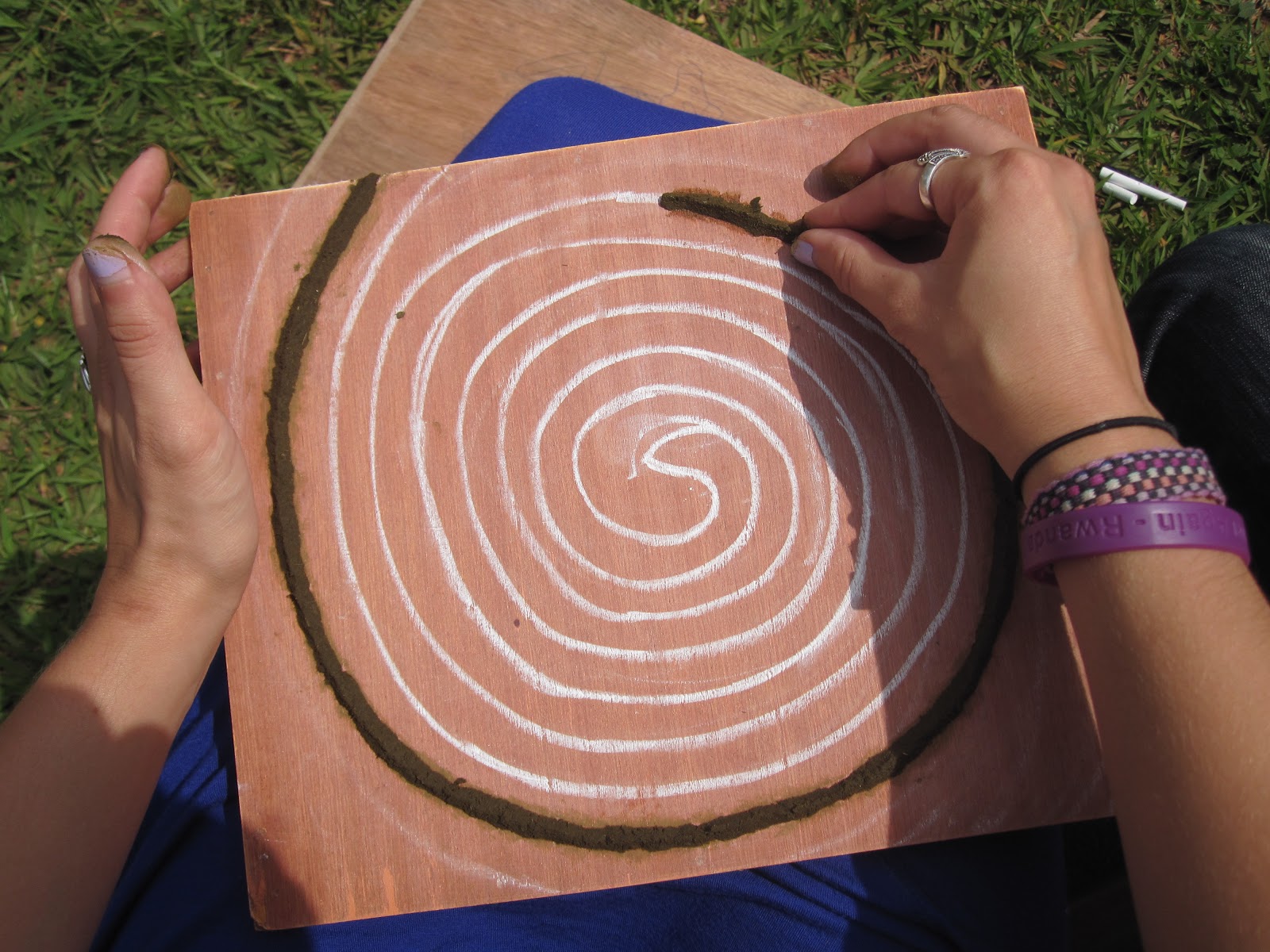
I met the AGATAKO women yesterday. The AGATAKO are those who make the traditional art. They sit on the stoops of the Avenir cooperative together, talking about the neighborhood, joking, calling each other bossy, as they roll tiny snake pieces of mixed tree ash and cow poop together and follow the chalk lines on the wooden board. They are making Ingubo -- "shield" -- Amatama -- "well-designed" -- and Impalage -- "zebra" -- to sell at the cooperative. They welcomed me immediately, and we all talked -- me, Emmanuel and the women. I told them I wanted to make the art, too. They told me I was one of them now. And they pulled me on to the stoop.


"No!" They'd insisted at first after I'd asked to make the art. "We don't want your hands to smell like poop!"

I know they had just met me, but they obviously didn't know me very well. Because poop-smelling hands is no problem for me, especially when it means I am apart of their art. They sat close to me and showed me how to manipulate the clay-like poop substance. They showed me how to spit on my fingers to keep the substance moist and when we all ran out of spit, Emmanuel went to the store to buy suckers.


This particular piece of traditional artwork has a meaning, and in fact, it is the piece I was attracted to and bought the first time I visited Avenir. It is painted with black and white and represents a person's life; it shows how life begins and how it continues. I look at it and feel dizzy and uncertain and comforted and inspired all at once; such is life. 

Lost in translation.

But not this. This experience needs no translation. I am a woman. You are a woman. I understand you.

Yanna

Sunday, June 17, 2012

The orange mask

The sheer orange scarf falls away to reveal her right arm.
She is missing her hand.

She is sitting between two men.
To the left, her husband, stoic, serious, lifeless.
To the right, the man who cut off her hand.
She sits next to the man who cut off her hand and assumed she was dead; he left her with his animal friends who hacked at her face with machetes.

People can be taught to be cruel.

The white in his eyes is flashing, but he is gentle with her, and they lean their heads close together and whisper.
What are they talking about?
As her husband sits poised,
a statue. Nonexistent.
What does he think of this man?

People can be taught to forgive.

But what sickness of lies will eat them from their guts when they realize
the script of reconciliation?

The Interhamwe said they didn't have a choice.
To accept the French machetes.
To spit on the faces of their cockroach, dehumanized victims.
To rape women and cut their stomachs.
To burn churches.
To crush infants against walls.
To kill.

Now, I ask you, woman in the orange scarf -- do you have a choice not to forgive?

Saturday, June 16, 2012

Magnolia syrup


Magnolia syrup does not exist. But this girl, with the tropical magnolia tucked behind her ear, has an idea for a new treat. Now, to channel the inner chemist within her. How can she turn this flower, which smells like biting into peaches and honey, into something bottled?


How can I bottle Rwanda?

Ha! What a ridiculous and slightly horrific idea. Ah, but I've already reached the halfway point, and I don't feel as though I've been able to tell you about Rwanda. I don't feel as though I've been able to tell myself. So, I've just been trying to catch senses -- literal senses like sight, taste, smell, touch and the cars and crows and shouts and songs and sizzles that I hear. 

Yesterday, I heard a man say this after someone pointed to a baby on a mother's back: "She carries her baby like that because we were all carried that way. I was carried like that when I was a baby. I'm sure Emmanuel was carried that way. We are all carried the same way."


Common ground. The human condition.

We all began the same way.

And we can connect through these realities. 

Connection.

Every day we eat together; we are hungry together. The colors of the food match their tastes. The colors are Earthy oranges, browns and greens, and I fill my entire plate with grains and meats and legumes that are creamy and complimentary. The cassava leaves are sweet, the texture melty and comfortable. The potatoes and bananas are thick with freshness. The avocados are velvet spoonfuls and can match the length of my hand. I mix this all with the rice, and I realize that what I'm eating came from dirt not too far away from where I am sitting.


I keep thinking about what the man said about the tradition of babies on mothers' backs and about the simplicity of salivary glands and digestion. We are all more similar than we think, yet we obsess with differences. We must all be better than one another, for what -- for self-actualization? For class success? For economic success? For power? Within every niche of life, there is someone who is striving to be better, and therefore is striving to be the best. Competition. Competitive nature. This helps us build cities and computer programs...as we grow further and further away from each other.

Just some magnolia syrup musings for tonight.

Tomorrow, we are going to the closing ceremony of the Gacaca Courts, the traditional court system used to bring justice to genocide survivors and jail perpetrators. The courts are closing. There will be no more testimonials. There will be no more sentences. So, it's over? Justice is fini?

Yet again, it's those in power who are making this decision. 

(Insert: Motives.)

Ay. I'll post more magnolia syrup musings tomorrow. 

Bonsoir.

Yanna

Tuesday, June 12, 2012

Where the wild things are

In the midst of being in a place where everything around me is bigger than I am, we went to Akagera National Park in northeastern Rwanda. Here, everything is bigger than me in a different way.

Quick personal history: When I was younger, I secretly wanted to be a marine biologist, even though I did not particularly like science. The only science class I really liked was astronomy, and that would not help in my potential marine biology profession. I also was not a very good swimmer. I never learned how to properly dive, and the swimming instructor always had to hold my ankle and flip me into the water so I wouldn't belly-flop.

Don't ask me why. But I wanted to be a marine biologist. Kind of. I also wanted to be an actress and a singer and a writer and a humanitarian.

I love animals. That's what it is. When I'm running on the treadmill at the Rec Center, I watch "River Monsters" on Animal Planet. When I see a random dog on the street, my voice transcends octaves into a horrifying baby-screeching: "Awwww doooggiiieee!" It's embarrassing. When I went snorkeling in the Pacific Ocean, I almost hyperventilated when a bat ray swam under me, its movement so effortlessly cool.

The trip to Akagera was my first safari. It goes without saying that my voice was looping in and out of soprano ranges.

The drive to Akagera was beautiful. We saw rice fields and sorghum fields and cassava trees and banana trees. We passed through villages where women carried their babies wrapped in scarves around their waists, men balanced planks on their topheads and children chased each other in the yards. At this house, Emmanuel asked the driver to stop so he could buy two bunches of sorghum for 4,000 francs. The photographs that follow are little capsules into my car ride view.


When we reached the park, we doused ourselves with bug spray and set off with our guide. The terrain was jostling, but this was the real deal. We opened the windows and did not blink. First, we saw impalas, which are like deer; this is where it began. Then came baboons and boar and hippos and zebras and a grand, graceful giraffe that lumbered off after staring at us -- the strange white boxy creature in front of it -- for a few minutes.


Disclaimer: Please note that all of these pictures are of animals running away from us, but that I actually think they were very happy to see us. Except the boar. They didn't move an inch. Couldn't be bothered.


Then there was this moment. The moment when a hippopotamus appeared from behind the bush, scooted in front of us and then slipped into the lake. It was unreal at first, the fact that a hippo was in my presence -- was this a character from one of my favorite children's books? No, it was not 2D, it was 3D and it was here with me.


And how could I forget the water buffalo, creatures who stick closely together and stare at us as we stare at them. Here, the last of the wild things.


And finally, here are the other wild ones. I hope you've enjoyed your virtual safari tour! Ijoro ryiza.


Yanna